Case Study: Collaborative Filter Design Enables Multispectral Imaging
Overview
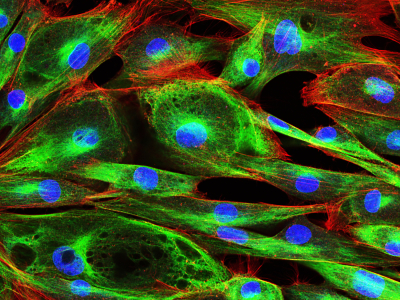
A customer developing a multispectral fluorescence imaging system needed custom optical filters capable of resolving seven fluorescent dyes across eight image volumes. Chroma engaged from day one, providing modeled spectral curves alongside initial proposals and refining the filter set through iterative design reviews over two years. Close collaboration resolved spectral, mechanical, and scheduling challenges—delivering filters that matched expected performance at first assembly.
Industry: Life sciences instrumentation
Application Area: Multiplexed fluorescence imaging of biological tissue
Technology Focus: Custom multi-notch filters, bandpass filters, dichroics, and compensation plates for multi-camera fluorescence detection
Challenge
Without early collaboration, the system risked being designed around filter performance that couldn’t realistically be achieved.
The instrument used four cameras and three dichroic beam splitters to separate fluorescence signals across multiple detection paths. This created compounding requirements:
Multi-notch filters required >OD6 blocking at several excitation laser lines while maintaining high transmission in adjacent emission bands.
Several filters also served as compensation plates, demanding tight thickness tolerances alongside demanding spectral performance.
Components up to 4” × 4” required high-quality reflected wavefronts after coating—sensitive to coating stress and uniformity across large apertures.
Staged deliveries to teams in Germany and the United States added coordination complexity under a tight schedule.
Solution
Rather than quoting against the initial specification alone, Chroma provided modeled spectral curves with its first proposal. This let the customer’s engineers run realistic system simulations early, revealing spectral overlaps that could have degraded dye separation had they gone unaddressed.
Over multiple design iterations, the teams refined the full filter set. Key adaptations included:
Redistributing performance requirements across two filter elements when single-filter designs exceeded manufacturing margins.
Replacing dicing with precision milling for thick substrates, improving dimensional accuracy and enabling recovery of partially damaged components.
Multiple coating iterations on multi-notch filters to achieve the required blocking depth across large substrates.
Key Features

Alignment
Compensation elements aligned correctly within the optical assembly.

Spectral measurements
Matched modeled performance, supporting the planned fluorescence separation strategy.

Delivery
Staged international deliveries were coordinated successfully, keeping the program on schedule.

Process improvements
Milling vs dicing reduced scrap and recovered usable components.
Implementation
Specification Hand-Off
Joint Design Review
Prototype Fabrication Validation
Staged Delivery and Final Integration
Conclusion
The most successful multispectral filter programs engage specialists early, design at the system level, and build in flexibility — because trade-offs between blocking depth, edge slope, and manufacturability rarely surface in simulation alone. As spectral architectures grow more complex, filters are no longer a late-stage procurement decision. The most reliable path to a working instrument starts with solving the filter problem together.
As spectral architectures grow more complex, filters are no longer a late-stage procurement decision.
Does your sensor application demand more than off-the-shelf optics?
Custom filter design starts with understanding your measurement challenge. Our optical engineering team can help you find the right optical filter to match your application.