Raman Spectroscopy Application Guide
Basics of Raman Spectroscopy
Raman spectroscopy is an application used to study the rotational, vibrational and other low-frequency modes in a system. This technique relies on the Raman scattering (inelastic) of monochromatic light, typically from a laser source. The laser light will interact with the specific bonds and electron clouds of a molecule to create a virtual energy state. The laser light interactions with these phonons (molecular vibrations) in the sample will result in the photon’s energy being shifted up or down. These shifts in the energy level (different rotational/vibrational states exhibited as either longer or shorter wavelength photons upon relaxation from the virtual energy state) give information about the phonon mode and therefore information about the sample.
The Raman scatter is so weak that the major challenge is to block both the intense laser light illuminating the sample and the Rayleigh scatter close to the laser in wavelength. Until recently this could only be accomplished with holographic devices using multiple steps of dispersion with the final signal going to a photomultiplier tube. This was difficult to align, expensive and slow. With the development of more powerful and less expensive lasers and the achievements in interference filter designs and better CCD cameras, the newer Raman spectroscopy devices are both less expensive and easier to operate.
While Raman spectroscopy may be primarily used for chemical analysis (by recognizing the unique signal from different molecules and specific chemical bonds), it is also used in a wide variety of applications from materials science, crystallography and mineralogy to microscopy (also called microspectroscopy).
Filter Requirements for Raman Spectroscopy
A major optical challenge in Raman applications is suppressing direct and scattered excitation light before it reaches the detector. This happens to be true of all fluorescence applications but is even more important here, because the primary job of the emission filter is not to transmit the emission but rather to block the excitation load.
It is also very important in this application, as it is in all applications involving lasers, that the laser source itself be ‘clean’ by restricting the output since many lasers have emissions well outside their stated emission points.
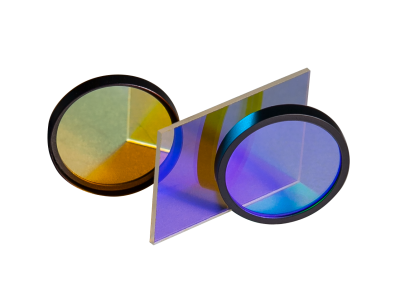
A laser clean-up filter in the 10–20 nm FWHM range is often used, together with an emission filter that blocks this band to greater than OD6. The dichroic mirrors in these applications must meet the requirements of standard laser configurations.
Additional Resources
Still Have Questions?
Our applications team works with Raman setups across most major commercial platforms. Tell us your laser line and we'll point you in the right direction.